RIRS
Laser removal
A fibre-optic scope is passed up to the kidney. The stone is broken with a laser or taken out with forceps, usually under general or spinal anaesthesia. There is no open cut on the abdomen or the back.

Services
Urology
Care of the urinary tract in men, women, and children, and of the male reproductive system. Kidney and ureteric stones are treated according to size and position. Prostate conditions are seen in the same department.
RIRS
A fibre-optic scope is passed up to the kidney. The stone is broken with a laser or taken out with forceps, usually under general or spinal anaesthesia. There is no open cut on the abdomen or the back.
Flexible ureteroscopy
The scope travels through the urinary passage to any part of the kidney. Stones are broken with a mechanical device rather than a laser, up to about 3 cm, and the procedure is used at any age. Most patients stay one day and return to work in about three days. Anaesthesia is spinal or general.
ESWL
Shockwaves from outside the body break a smaller stone in the kidney or ureter into fragments that can pass in the urine. A session lasts 40 to 45 minutes and is done as day care, without an incision or an overnight stay. If larger pieces remain, a further session may be needed.
PCNL
A small opening is made in the back to reach a larger stone in the kidney. The stone is removed through that track. This is used when a stone is too large for laser, ureteroscopy, or shockwave treatment, and it avoids a full open operation.
Women’s health
Antenatal care runs from the early months of pregnancy through to delivery. Birth is in a private suite, with postnatal care afterwards for mother and baby. High-risk pregnancies are managed in the hospital.
Nursing cover in the maternity unit continues through the night, including for women admitted before labour and for those who need observation after birth.
Surgery
General surgery covers laparoscopic operations and open surgery. The operating theatre, radiology, and laboratory are in the hospital, so the imaging and blood tests used to plan an operation are done on site.
Emergency surgical admissions are accepted 24 hours. Patients who need a scan, a blood test, or medicines before discharge use the hospital’s own radiology, laboratory, and pharmacy.
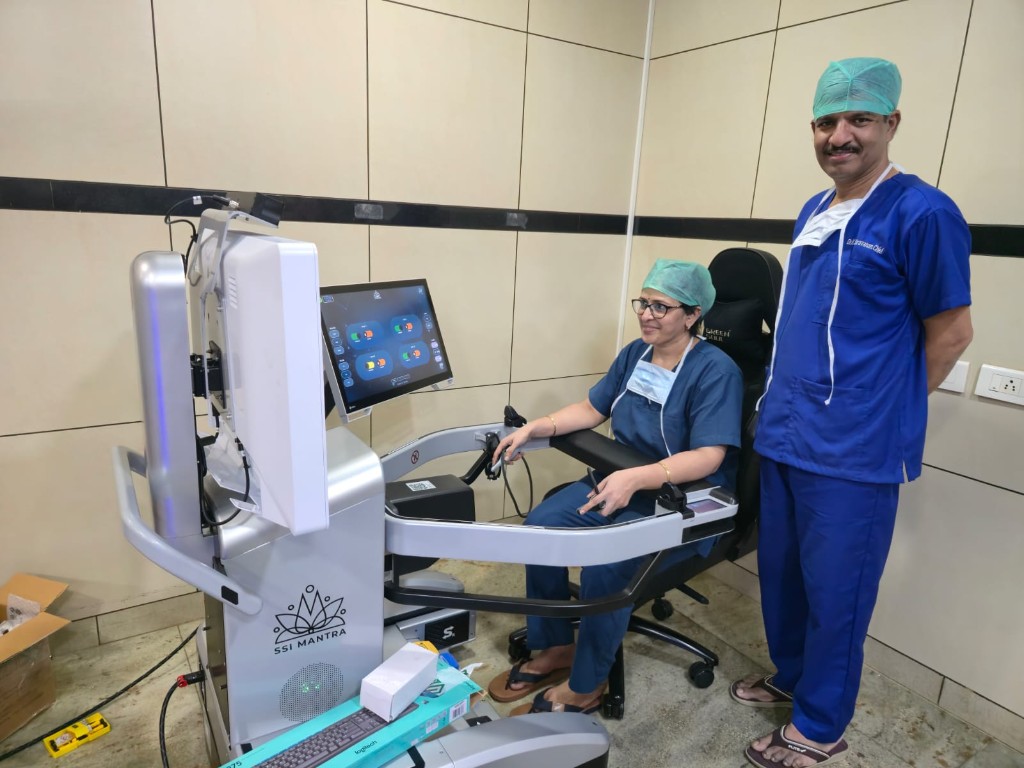
Newest service
The surgeon works from the SSI Mantra console. Procedures are done through small incisions. The theatres also cover laser and keyhole stone surgery, laparoscopy, and open surgery.
The hospital
Medical care of kidney disease, for patients seen in consultation or admitted to the hospital.
Assessment and treatment of acute illness, and follow-up of longer medical conditions, for adults admitted to the hospital or seen in consultation.
Imaging for urinary stones, pregnancy, and the planning of surgery. Reports are issued in the hospital, for use at the same visit or admission.
Blood tests, urine tests, and other investigations needed before a consultation, an operation, or discharge. Samples are processed in the hospital laboratory.
Prescriptions are dispensed in the hospital, including medicines started on the ward and those given at discharge.
Emergency care for adults and children, with nursing and inpatient beds available through the night. The number to call is +91 4142 231662.